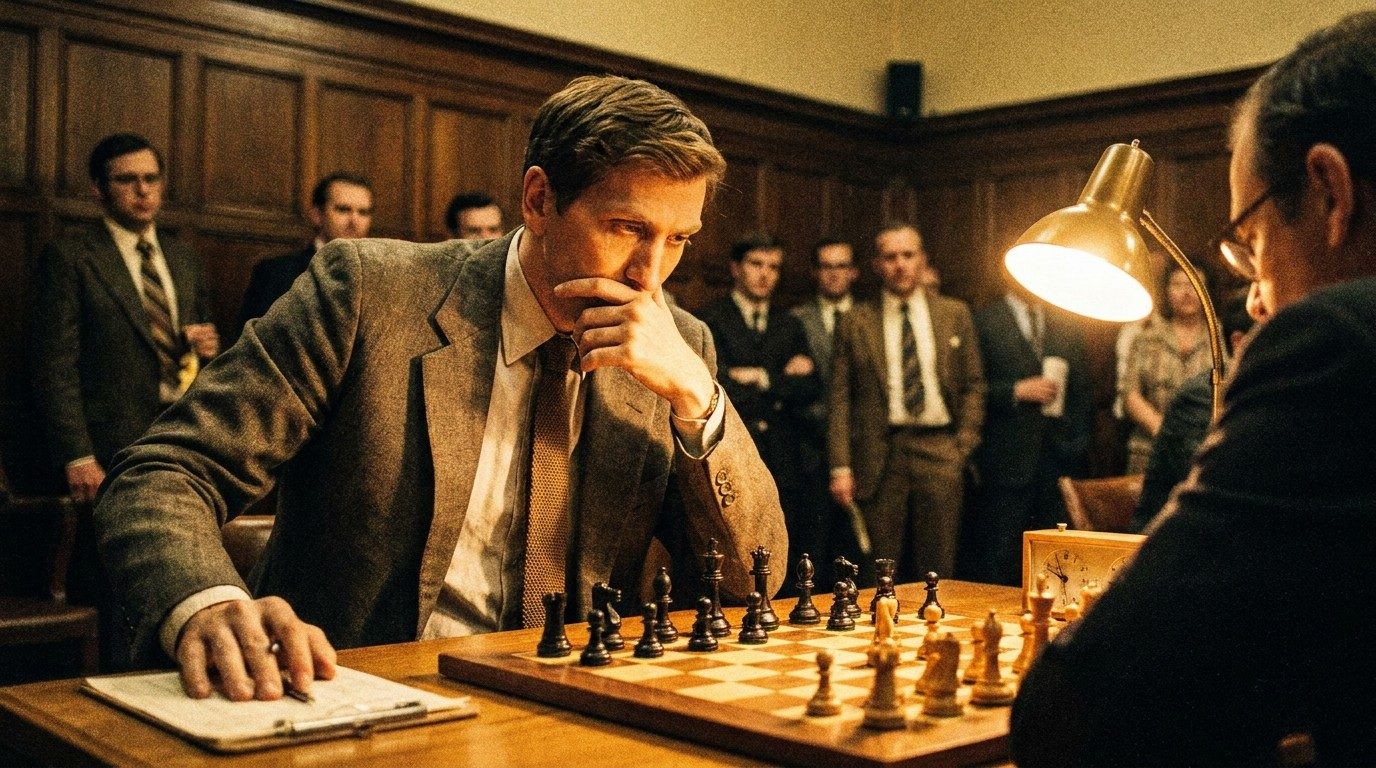
Bobby
Fischer
Career overview
His victory in the 1972 World Championship against Boris Spassky is often regarded as a pivotal moment in chess history, symbolizing a Cold War confrontation between the United States and the Soviet Union.
Career honours
Records
Biography
Early Life & Origins
Bobby Fischer was born in Chicago, Illinois, to Regina Wender Fischer and Hans-Gerhardt Fischer. Raised in a single-parent household, he showed an early aptitude for chess, learning the game at age six. His mother, a teacher and physician, played a significant role in his upbringing, fostering his intellectual pursuits.
Rise to Prominence
Fischer became a chess prodigy, winning his first U.S. Championship at the age of 14. His remarkable talent was evident as he achieved a perfect score in the 1964 championship, the only instance in the tournament's history. By the early 1970s, he had established himself as a leading contender for the World Championship.
Playing Style & Technique
Fischer was known for his aggressive and innovative playing style, often employing deep strategic thinking and psychological tactics against his opponents. His meticulous preparation and ability to exploit his rivals' weaknesses set him apart, making him a formidable competitor on the chessboard.
Defining Moments & Achievements
Fischer's most notable achievement came in 1972 when he defeated Boris Spassky in a match that captured global attention. This victory not only earned him the World Championship title but also marked a significant cultural moment during the Cold War, symbolizing American superiority in a domain long dominated by the Soviet Union.
Rivalries & Era Context
Fischer's career was marked by intense rivalries, particularly with Soviet players like Tigran Petrosian and Boris Spassky. His matches against Spassky were particularly significant, as they represented a clash of ideologies during the Cold War. Fischer's refusal to defend his title in 1975 further solidified his complex relationship with the chess community.
Legacy & Impact
Bobby Fischer's impact on chess is profound, influencing generations of players and popularizing the game worldwide. His contributions include the development of Fischer Random Chess and innovations in time control. Despite his controversial views later in life, his legacy as one of the greatest chess players endures.
Stats in detail
Career Overview
Bobby Fischer's career statistics highlight his dominance in chess during his active years.
| World Championship Matches | 1 |
| U.S. Championships | 8 |
| Matches against Spassky | 1 |
Major Tournaments
Fischer's performance in major tournaments showcases his exceptional skill.
| Interzonal | 5th-6th (1958) |
| Candidates Matches | Won against Taimanov and Larsen (6-0 each) |
| World Championship 1972 | Won against Spassky (12½-8½) |
Olympiad Performance
Fischer's contributions to the U.S. team in Olympiads were significant.
| 1960 Olympiad | 10 wins, 6 draws, 2 losses |
| 1962 Olympiad | 8 wins, 6 draws, 3 losses |
| 1966 Olympiad | 14 wins, 2 draws, 1 loss |
Career timeline
Latest Fischer News
All 32 stories →
 Netherlands
 Norway
 United States
 Russia
 India
India